
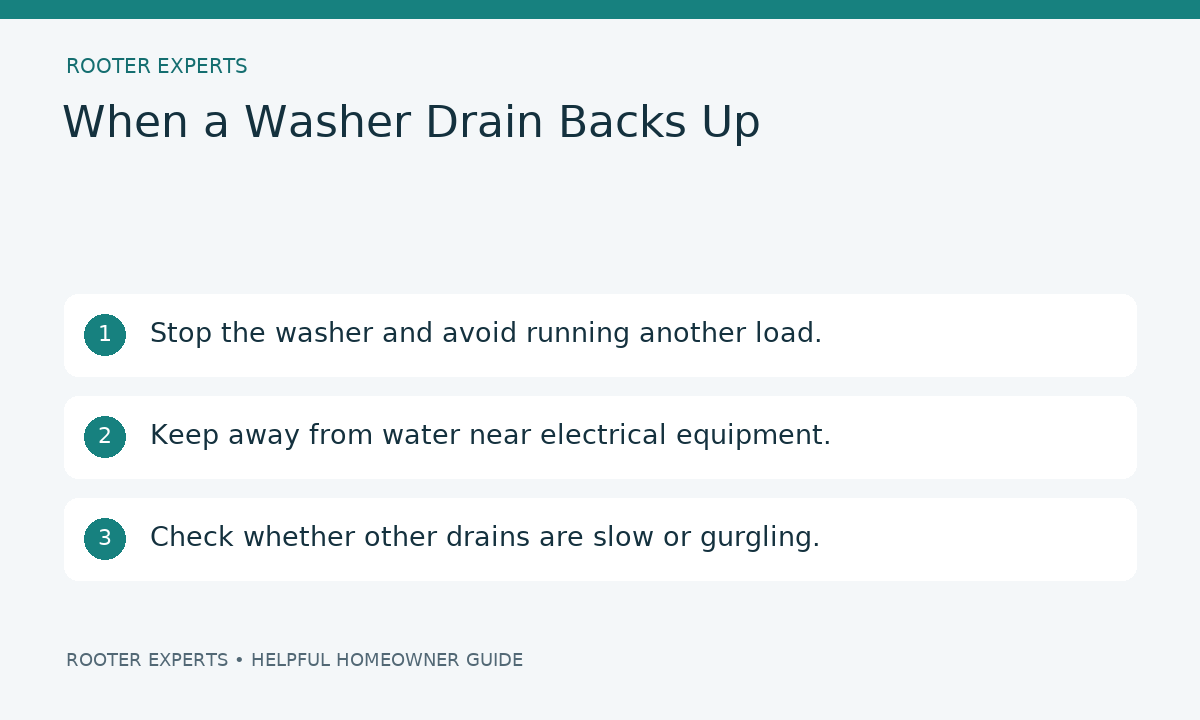
If your washing machine drain backs up into the basement, stop adding water to the affected drain system. Do not run another load or flush other fixtures to test it. Another discharge can turn a small overflow into a larger one.
Keep children and pets away. If water is near the washer’s plug, cords, electrical panel, or other electrical equipment, stay out of the wet area and do not touch that equipment. Power should be switched off only from a safe, dry location. If you cannot safely reach the panel or identify the circuit, leave the area and get professional help. The CDC’s electrical-hazard guidance warns against operating electrical switches or appliances while standing in water. Waterproof gloves and shoes do not make that safe.
First steps during a washer-drain overflow
- Stop the washer safely. If the controls are dry and reachable from a dry spot, follow your model’s stop/pause instructions. Do not assume that canceling a cycle stops water discharge: Whirlpool explains that canceling some washer cycles drains the tub. Avoid a Cancel/Drain or drain-and-spin command during an overflow.
- Pause other water use. Avoid sinks, showers, toilets, and the dishwasher while the backup is being assessed. Do not deliberately run them to see which drain overflows next.
- Observe from a safe, dry spot. Note whether water came from the washer standpipe—the upright pipe holding its drain hose—a utility sink, or a floor drain. You do not need to touch the water to report what happened.
- Leave the hose and pipes in place. Pulling out the drain hose or opening a pipe can release trapped water. Do not pour chemical drain cleaner into the opening.
Move dry belongings only if you can do so without entering the wet area. If a drain product was already used, keep its label and tell the technician where it was poured.
Laundry branch or a wider drain problem?
Use what you already noticed before stopping water use. A problem confined to the standpipe or nearby utility sink may involve the laundry branch. If other fixtures had been draining normally, that is useful information to report, but it does not rule out a restriction farther along the line.
Several slow drains, toilets gurgling during laundry, or water rising at a lower fixture suggest that more of the shared drain system may be involved. A floor-drain backup during the washer’s discharge is a reason to have the drainage path checked; the location of the overflow alone does not prove where the blockage sits.
Our main sewer line clog symptom guide explains those broader patterns. If the backup followed a storm rather than a wash cycle, see the separate heavy-rain basement-drain guide.
What to report when calling for help
A short description is enough to start:
- Where the water first appeared and whether it happened as the washer emptied.
- Whether other drains had been slow or gurgling before you stopped using them.
- Whether this has happened before, including after a previous cleaning.
- Any chemical product or drain tool already used, and any nearby electrical hazard.
If a snake is already stuck, do not force or reverse it based on general advice. Follow the specific tool’s instructions and review the stuck drain-snake guidance.
What happens at a drain-service visit?
The technician can assess the laundry connection and the drain it feeds, then recommend a method suited to the access point, blockage, and pipe condition. A recurring or unclear problem may need further inspection. A camera helps inspect an accessible pipe; it does not clear the blockage itself.
Rooter Experts provides drain cleaning and main sewer line cleaning in Northern New Jersey. Before authorizing work, ask what the proposed service includes and how added work would be approved. For camera-specific questions, use the inspection estimate guide.
Keep the washer out of use until the affected drain has been assessed and cleared for use.
Talk with Rooter Experts
Call Rooter Experts at (201) 583-4778 to discuss your drain problem.