
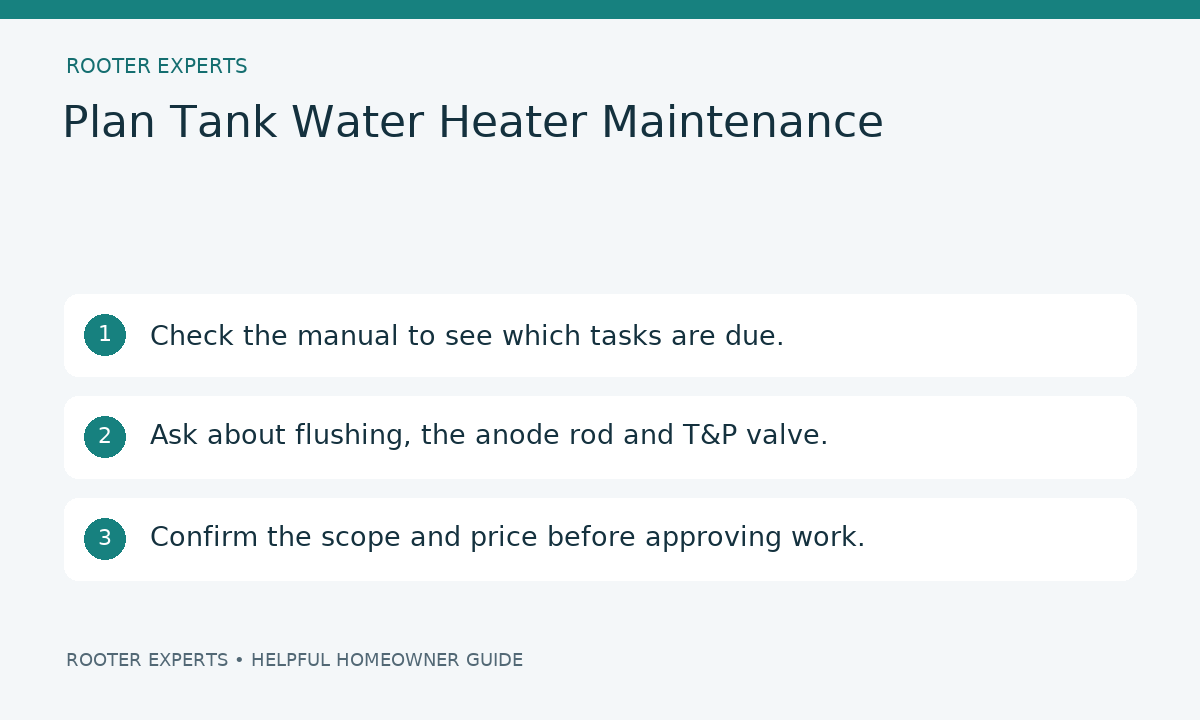
If your tank water heater still works well, start maintenance planning with its model number and owner’s manual. Ask a service provider which tasks are due: flushing the tank, checking the anode rod and checking the temperature-and-pressure relief valve. The schedule should come from your heater’s manufacturer, not a one-size-fits-all service offer.
A.O. Smith’s water heater leak-prevention guidance lists annual flushing, anode-rod checks and replacement, and relief-valve testing as typical maintenance tasks. It also tells owners to follow their manufacturer’s recommended schedule. Use those tasks to frame a service conversation, then confirm what applies to your exact model.
Flushing: ask about removing sediment
Sediment is material that settles inside the tank. A.O. Smith explains that minerals in hard water can collect at the bottom and contribute to overheating, cracks and leaks. The same guidance identifies regular flushing as a way to help prevent sediment buildup.
Before approving a flush, ask:
- Does my model’s manual call for flushing now?
- How does its past maintenance affect the recommended work?
- Does the proposed service include flushing, or only an inspection?
If you do not know when the tank was last flushed, say so. That gives the provider a clear starting point without guessing at the heater’s history. Leave draining and flushing to the service provider rather than opening the drain valve to prepare for the visit.

Anode rod: ask about condition, not automatic replacement
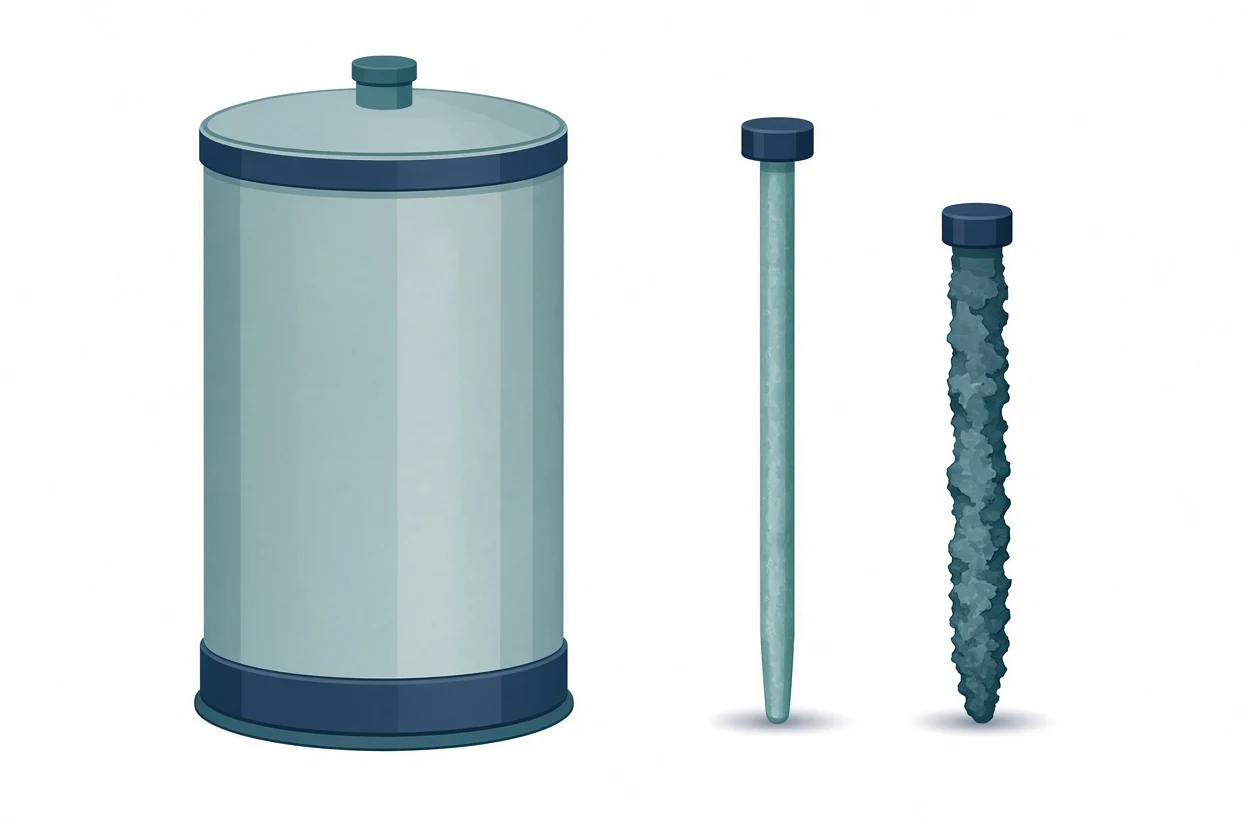
The anode rod is a part that corrodes to help protect the tank from rust. A.O. Smith calls it a “sacrificial” rod and says these rods usually last three to five years in its explanation of anode-rod wear.
That general range is not a replacement deadline for every heater. Ask the provider how your model’s rod should be checked and what finding would justify replacement. If replacement is recommended, request an explanation of its condition and the part proposed for your heater.
A useful service record should distinguish between a rod that was checked and one that was replaced. Keep that record with the manual so the next maintenance decision does not start from scratch.
Relief valve: confirm the model-specific check
The temperature-and-pressure relief valve is often shortened to the T&P valve. A.O. Smith includes testing it among the typical maintenance tasks listed above.
Ask whether the visit includes that check and whether the provider will follow your model’s instructions. Do not operate the valve as a pre-visit test. Have the provider explain the result and whether any further work is needed before you approve it.
Also ask whether the inspection covers visible leaks, corrosion or damage at the tank, valves and connections. Those are areas A.O. Smith identifies for regular inspection.
Turn the findings into a maintenance plan
Before booking, gather the heater’s brand, model number, approximate installation date and any service records you already have. Do not remove covers or take parts apart to collect this information. If the label is not readily accessible, tell the provider.
Ask for a written scope that separates inspection, flushing and any proposed parts replacement. Confirm the price for that scope and how additional work would be approved. After service, request the findings, work completed and next recommended maintenance date based on the manual.
If you discover an active leak while planning maintenance, switch to the leaking water heater safety guide rather than treating it as a routine appointment.
Discuss water heater service in Northern New Jersey
Rooter Experts Drain Cleaning provides water heater service in its Northern New Jersey service area, including Moonachie, Hackensack and Clifton. When requesting service, provide your town and heater model, then ask which maintenance tasks can be assessed for that unit. Confirm the proposed work before booking rather than assuming a standard maintenance package includes all three tasks.
Talk with Rooter Experts
Call Rooter Experts at (201) 583-4778 for plumbing or drain service in Northern New Jersey.