
Rooter Experts Blog
Main Sewer Line Clog Symptoms: What New Jersey Homeowners Need to Know
If several drains in your home are slow or backing up at the same time, the problem usually isn’t any one fixture — it’s the main sewer line that carries waste from the whole house to the street or septic system. Catching it early is the difference between a routine cleaning and raw sewage on your basement floor.
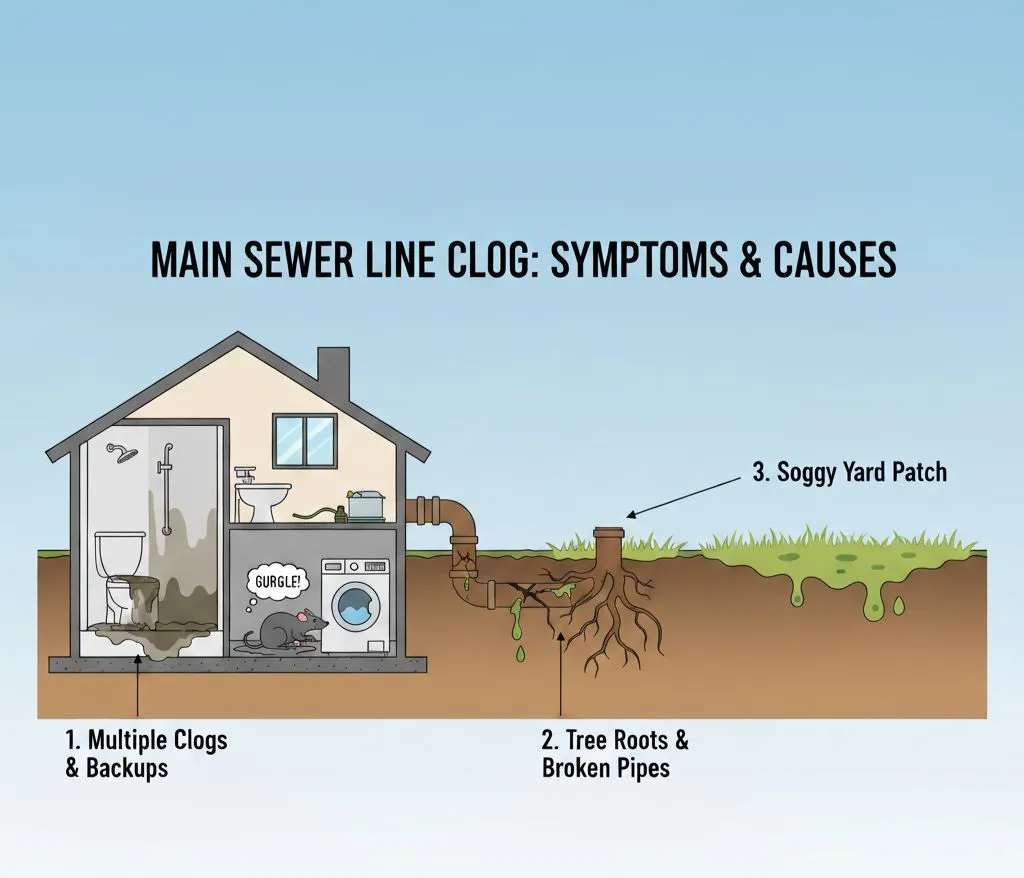
First question: one fixture, or the whole house?
A single slow sink or toilet is almost always a local clog in that fixture’s trap or branch line. A main line problem shows up in several fixtures at once — and the lowest drain in the house (usually a basement floor drain or first-floor tub) backs up first. If only one fixture is affected, start with our guide to toilet clog vs. main sewer clog. If two or more are involved, keep reading.
The 7 main sewer line clog symptoms
1. Multiple drains slow or backing up together
When the kitchen sink, bathroom drains, and toilets all run slow at once — or “sewage is not draining from the house” as homeowners often describe it — the blockage is downstream of every fixture, in the main line.
2. The toilet backs up into the tub or shower
This is the single clearest sign. Flush the toilet and watch the nearest tub or shower: if water rises there, waste has nowhere to go but back up through the lowest opening. “Toilet backing up into my shower” is one of the most common calls we get.
3. Gurgling and air bubbles across fixtures
A “tub that burps when the toilet is flushed,” or a toilet that bubbles when the washing machine drains, means trapped air is being forced past a partial blockage. Gurgling in a fixture you didn’t use points to the main line, not that fixture.
4. Sewage odor indoors or at the outside cleanout
A persistent sewer-gas smell inside, or around the outdoor cleanout cap in your yard, signals waste sitting in a blocked line instead of flowing away.
5. Water or sewage backing up unexpectedly
Dark water rising in a floor drain, tub, or shower — especially in the basement — is sewage backing up. Stop running water immediately if you see this.
6. A wet, soggy, or smelly patch in the yard
A lush, sunken, or foul-smelling area in the lawn — often “sewer back up in yard” — can mean the buried line is cracked or leaking, frequently where tree roots have broken in.
7. Clogs that keep coming back
If you’re plunging or snaking the same drain every few weeks, you’re treating a symptom. Recurring backups almost always trace to roots, grease, or a damaged section in the main line that needs a real diagnosis.
What causes main sewer line clogs in NJ homes
- Tree roots. North Jersey’s mature trees send roots into old clay and cast-iron joints chasing moisture — a leading cause of recurring main-line backups here.
- Grease, scale, and buildup. Years of grease, soap, and mineral scale narrow the pipe until a single bad day blocks it.
- Cracked, bellied, or collapsed pipe. Older clay, cast-iron, and Orangeburg pipe cracks, sags into a low “belly” where waste pools, or collapses entirely.
- Flushed items. “Flushable” wipes, paper towels, and feminine products don’t break down and snag on any imperfection.
- Heavy rain and ground shifting. Storms and freeze-thaw cycles stress already-damaged lines and push partial clogs over the edge.
What to do right now
If you suspect a main line clog:
- Stop running water — every flush and faucet adds to the backup.
- Don’t pour in chemical drain cleaner. It won’t reach a main-line blockage and can sit in standing water where someone has to work.
- Locate your outside cleanout (a capped pipe near the foundation) so a plumber can access the line quickly.
- Call a licensed plumber for a camera inspection before anything else.
How a professional finds and clears it
The right sequence protects you from guesswork and overpaying:
- CCTV camera inspection. A drain camera shows exactly what’s in the line — roots, grease, scale, an offset joint, or a low section where wastewater pools. You should see the cause on screen before approving work.
- The right clearing method. A cable (snake) can open a soft clog fast; hydro jetting uses high-pressure water to scour the full pipe wall and is the better tool for grease and roots. We choose based on what the camera shows — see hydro jetting vs. snaking for how they compare.
- A plan for what’s actually wrong. A clog gets cleared; a cracked or collapsed pipe needs repair, not just cleaning.
Repairs in New Jersey should follow the state plumbing code (such as N.J.A.C. 5:23-3.15) so the work is safe and lasting. For what cleaning typically costs and what drives the price, see our main sewer line cleaning cost guide.
Call the experts for sewer line problems in New Jersey
Don’t wait for a small clog to become a flooded basement. If you recognize these symptoms, Rooter Experts and Drain Cleaning has licensed plumbers with over 18 years of experience serving Bergen and Passaic County. We use camera inspection and hydro jetting to clear even root-packed lines — and we show you the problem before we fix it.
Call (201) 583-4778 for fast, flat-rate sewer line service in Moonachie, Bergen County, and across North Jersey — or request a free quote.