
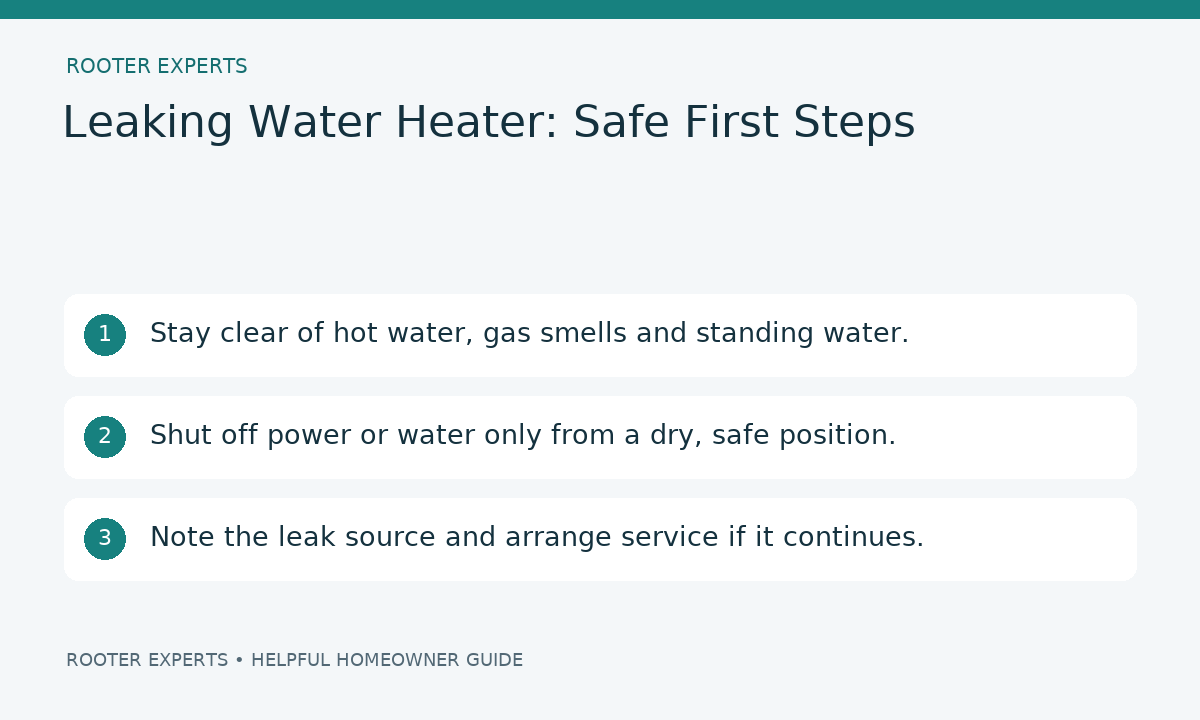
Water around a water heater can spread into walls, flooring and nearby equipment. Keep people and pets away, avoid the hot water, and do not step into standing water to reach the unit. If you can approach from a dry area, follow the steps below.
Watch for immediate danger
Leave the area and get appropriate emergency help if you notice:
- A gas smell
- Smoke, sparks or scorched wiring
- Steam or spraying hot water
- Water touching an electrical panel, outlet, cord or appliance
- A tank that looks swollen or badly damaged
If you smell gas, leave the building and move well away before calling 911 or your gas utility’s emergency line. PSE&G’s gas-leak guidance explains why you should leave switches, appliances and phones alone until you are safely outside. Do not try to find or shut off the leak yourself.
If electrical equipment is surrounded by water, do not enter the water. Gloves and boots do not make electrically hazardous water safe.
Shut down the heater only when it is safe
The correct shutdown step depends on the type of heater. A. O. Smith recommends isolating the heater’s energy supply before inspecting a leak, then shutting off its water supply. Follow your own model’s instructions and the safety limits below; a gas smell or wet electrical area means leaving the area, not approaching the controls.
For an electric water heater, turn off its labeled circuit breaker only if the electrical panel is in a dry, safely reachable place and your hands are dry. Do not guess which breaker controls it. The CDC warns against operating switches or electrical equipment while standing in water.
For a gas water heater, follow the shutdown directions printed on the unit or in its manual. Do not take apart the gas control, attempt a repair or move a gas valve when you are unsure what it controls.
If you cannot identify the heater type or reach the controls safely, stay away and arrange professional help.
Limit the incoming water
Look for the cold-water supply pipe entering the heater and its shutoff valve. Close that valve only if it is easy to identify, dry and safely accessible. Do not force a stuck or corroded valve.
If the local valve cannot be used and water is spreading quickly, the home’s main water shutoff may stop additional water from entering the plumbing system. Use it only if you know where it is and can reach it without crossing standing water. Remember that this shuts off water to the whole home.
Even after the supply is closed, water already inside the tank or pipes may continue to escape. Do not drain the tank unless a qualified professional directs you to do so.
Find the leak area without taking anything apart
Use a flashlight and observe from a dry position. Do not touch the water, pipes or tank because they may be hot. Check where the first visible water appears:
- At the top: Look around the pipe connections above the tank.
- From a side pipe: Note whether water is coming from a valve or discharge pipe. Never cap, plug or clamp a discharge pipe.
- Near the bottom valve: Water may be collecting around the drain valve.
- Under the tank: Look for water emerging from the base or outer shell.
- Beside the heater: Check whether a nearby pipe, drain, furnace or other appliance could be the actual source.
Water can travel along a pipe or floor before forming a puddle. The wettest spot is not always where the leak began, so record what you can see rather than trying to confirm the cause yourself.
Control the water already on the floor
If the area has no electrical, gas or hot-water hazard, place towels or a shallow container where water is dripping. Move dry belongings away from the area. Do not lift or tilt the heater.
For a large or continuing leak, focus on keeping people out of the area and stopping the water supply safely. Avoid using a household vacuum, fan, extension cord or other powered device near the wet floor.
Record these details before requesting service
A short set of notes can help explain the problem:
- Whether the heater is gas, electric or another type
- Where water first becomes visible and whether it is dripping, running or spraying
- Any steam, sounds, odors or warning lights you noticed from a safe position
- The model and serial number, if readable without entering the wet area
- Clear photos taken from a safe, dry position
- Whether you shut off the heater, its water supply or the home’s main supply
Mention any recent work on the heater. Do not touch the leaking water to check its temperature or restart the unit to see whether the leak returns.
Arrange water-heater service
Arrange service when the leak continues, comes from the tank or a valve, returns after cleanup, or cannot be traced safely. A technician can identify the source and explain whether the affected part can be repaired or whether replacement should be considered.
Rooter Experts offers water-heater service in Northern New Jersey. If the unit is older and you are weighing repair against replacement, the water-heater lifespan guide can help you prepare questions before the visit.
Leave the heater shut down until a qualified professional says it is safe to use. Do not restore power or relight it just because the visible dripping has stopped.
Talk with Rooter Experts
Call Rooter Experts at (201) 583-4778 to discuss your plumbing or drain problem.