
Rooter Experts Blog
Is Drain Cleaner Acidic or Basic? Understanding pH Levels and How They Work
Is water backing up into your sink or bathtub right now? Before you pour a bottle of chemicals down that drain, pause. You might be wondering, ” Is drain cleaner acidic or basic, and ” Does it really matter? Most commercial drain cleaners are highly alkaline (basic), with pH levels between 12 and 14, though some professional-grade products use strong acids with pH levels of 0 to 2.
As a locally owned Emergency Plumbing Service in Northern NJ, we see the aftermath of chemical cleaners every week. A $10 bottle of cleaner can cause thousands of dollars in damage to older Bergen County plumbing systems. Here is the honest truth about how these chemicals work and why mechanical cleaning is the only safe solution.
What is the pH of Drain Cleaner?
Most common household drain cleaners are basic (alkaline) and typically contain sodium hydroxide (lye) or bleach. These have a high pH (12-14) to cut through grease and hair. However, some heavy-duty or “professional strength” cleaners sold in hardware stores are highly acidic (sulfuric acid), with a pH near 1.
Key Takeaway: Both extremes on the pH scale are corrosive. Whether a drain cleaner is acidic or basic, both rely on causing a violent chemical reaction inside your pipes to burn through a clog.
How Drain Cleaners Work Chemically
To understand the risk, you have to understand the chemistry. Drain cleaners are not “soaps”—they are caustic agents designed to create heat and decomposition.
Alkaline Drain Cleaners (The “Bases”)
- Primary Ingredient: Sodium Hydroxide (Lye) or Sodium Hypochlorite (Bleach).
- Target: Grease, fats, oils, and proteins (hair).
- The Mechanism: When these high-pH bases hit the clog, they trigger a process called saponification. Essentially, they turn the grease in your clog into a soap-like substance that can dissolve in water. This process also generates heat, which helps melt the blockage.
Acidic Drain Cleaners
- Primary Ingredient: Sulfuric Acid or Hydrochloric Acid.
- Target: Paper products, food scraps, and mineral buildup.
- The Mechanism: Acid cleaners work by donating protons to the clog, breaking down chemical bonds rapidly. This creates a hydrolysis reaction. Warning: Acidic cleaners generate intense heat—enough to melt plastic or crack porcelain if not handled correctly.
The Hidden Dangers for Northern NJ Homes
If you live in Moonachie, Ridgewood, or anywhere in Bergen and Passaic Counties, your home likely isn’t brand new. This is where the question “is liquid drain cleaner corrosive?” becomes critical.
The “Old Pipe” Factor
Many homes in our service area built between 1940 and 1980 still utilize cast iron or galvanized steel piping.
- Acidic Cleaners vs. Cast Iron: Acid eats metal. Using a sulfuric acid drain cleaner in an old cast-iron line can erode through the pipe’s bottom, causing the line to collapse or leak sewage into the ground.
- Alkaline Cleaners vs. Old Pipes: While less aggressive on metal than acid, lye-based cleaners can crystallize inside old, rough pipes, actually creating a harder clog than the one you started with.
The Plastic Pipe Risk
Even if you have modern PVC or ABS pipes, the chemical reaction is dangerous. The heat generated by these chemicals (an exothermic reaction) can soften, warp, or melt the plastic glue joints. We have seen P-traps completely deformed by homeowners trying to save a few dollars on a Drain Cleaning Service.
Acidic vs. Basic vs. Professional Cleaning
Here is a breakdown of your options when facing a stoppage.
| Feature | Alkaline (Drano / Liquid-Plumr) | Acidic (professional strength) | Mechanical (snaking / hydro jetting) |
|---|---|---|---|
| pH level | Basic (11–14) | Acidic (0–1) | Neutral (mechanical) |
| Best for | Minor hair or grease clogs | Paper or organic solids | All clogs, roots, and hard blockages |
| Safety risk | Moderate (skin burns, fumes) | High (severe burns, pipe damage) | Low |
| Pipe damage | Low to moderate | High (corrosion risk) | Minimal |
| Cost | $10–$20 | $20–$40 | Varies |
Why a Licensed Plumber Doesn’t Use Chemicals
At Rooter Experts, we believe in transparency. When you call us for Rooter Service NJ, you won’t see us pouring jugs of acid down your sink. Here is why.
1. We Need to See the Problem
Blindly pouring chemicals is guessing. We use camera diagnostics to see if the blockage is a grease ball, a tree root intrusion, or a collapsed pipe. Chemicals cannot fix a tree root; they just flow past it while poisoning the soil.
2. Chemicals Don’t Clear the “Full Bore.”
Liquid cleaners generally burn a small hole through the bottom of the clog (the path of least resistance). The water drains away, but 90% of the gunk remains on the pipe walls. The clog will return in weeks.
3. Hydro-Jetting is Superior
For serious backups, we use Hydrojet Plumbing Service. This uses high-pressure water (not chemicals) to clean the inside of the pipe, restoring it to near-original condition without damaging the infrastructure.
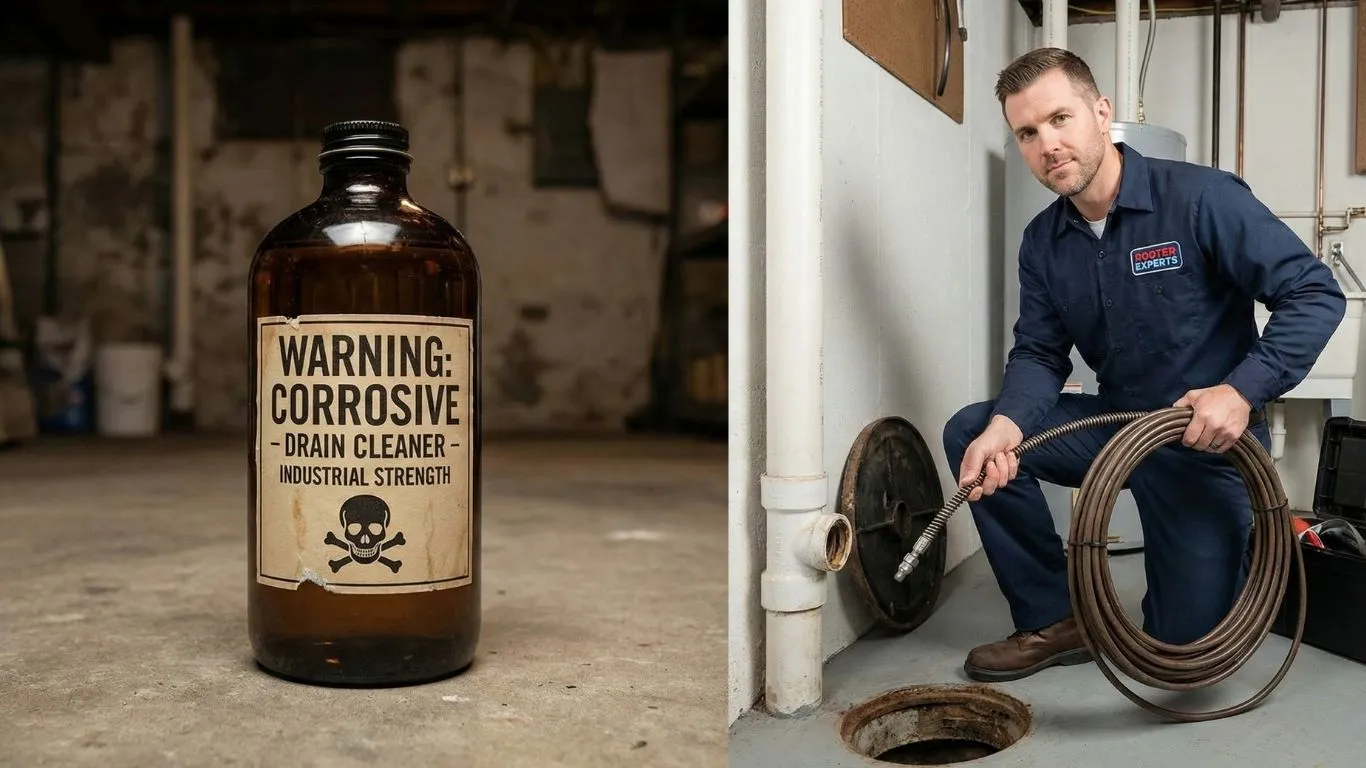
Licensed Plumber Doesn’t Use Chemicals
When to Call a Professional in Northern NJ
If you have used a store-bought cleaner and the water is still standing, stop immediately. Adding more chemicals will only increase the pressure on your pipe joints and create a hazardous pool of toxic water.
You need a physical solution.
- Gurgling noises from the toilet.
- Water is backing up in the shower when you flush.
- Multiple drains are clogging at once.
These are signs of a main sewer line issue that no chemical bottle can fix.
FAQ About: Is drain cleaner acidic or basic?
Can I mix acidic and basic drain cleaners?
ABSOLUTELY NOT. Never mix different drain cleaners, and never mix any drain cleaner with bleach. Mixing bleach (or another chlorine-based product) with an acidic cleaner releases chlorine gas, which is highly toxic. If you poured one product and it didn’t work, do not add a different one — call a professional immediately.
Is vinegar an acidic drain cleaner?
Yes, vinegar (acetic acid) is a mild acid with a pH of around 2-3. When mixed with baking soda (a mild base), it creates a fizzing reaction that can help dislodge minor clogs. It is safe for pipes but often not strong enough for main sewer line backups.
Why does my plumber hate drain cleaners?
Beyond the damage to pipes, it is a safety hazard for us. If you pour acid down the drain and then call us for Plumbing Services NJ, that acid is sitting in the P-trap. When we cut the pipe or remove the trap, that chemical can splash onto our skin or eyes. Always tell your plumber if you have used chemicals recently.
Do enzymatic drain cleaners work?
Enzymatic cleaners are neither highly acidic nor highly basic. They use bacteria to eat organic waste. They are safe for pipes and septic systems, but work very slowly (overnight or days). They are good for maintenance, not emergencies.
Conclusion
Most drain cleaners are highly alkaline (basic), with pH levels of 12-14, using sodium hydroxide to dissolve organic clogs through heat and a chemical reaction. Some professional-grade products are highly acidic (pH 0-2) and use sulfuric acid, but they pose greater risks, particularly to the older pipe systems common throughout Northern New Jersey.
At Rooter Experts and Drain Cleaning, we solve the problem at the source. We are locally owned, fully licensed, and equipped with the cameras and tools to handle your emergency without upselling or dangerous chemicals.
Call Rooter Experts today at (201) 583-4778 for honest, clear, and safe drain cleaning.
Need a drain or sewer line cleared in North Jersey? Rooter Experts and Drain Cleaning offers flat-rate, camera-verified drain cleaning across Bergen and Passaic County — no upselling, no surprise charges. Call (201) 583-4778 or get a free quote.