
Rooter Experts Blog
How Does Drain Cleaner Work?
Drain cleaners work by creating a chemical reaction using strong acids (such as sulfuric acid) or alkalis (such as sodium hydroxide/lye). When poured down a drain, these chemicals donate or accept electrons from the clog material, generating intense heat. This heat melts grease, dissolves hair, and breaks down organic matter into a soap-like substance that can be flushed away. However, this same chemical heat can warp PVC and corrode metal pipes.
How Does Drain Cleaner Work?
Drain cleaners work by using chemical or enzymatic reactions to break down clogs, such as hair, grease and soap scum, into smaller, water-soluble particles that can be flushed away.
To do this, they rely on two primary mechanisms:
- Electron Transfer: Chemicals either steal electrons from the clog (oxidation) or give them away, breaking the molecular bonds holding the blockage together.
- Heat Generation (Exothermic Reaction): Many cleaners generate intense heat to melt grease and dissolve solids.
While effective on minor surface clogs, this chemical process can be risky for your plumbing infrastructure.
The 4 Types of Drain Cleaners: Chemistry Explained
To understand why drain cleaners are often a gamble for New Jersey homeowners, you need to understand the specific chemical reaction happening inside your pipes.
1. Caustic Cleaners (The Grease Melters)
- Active Ingredient: Sodium Hydroxide (Lye) or Potassium Hydroxide.
- How It Works: Caustic cleaners are bases. They donate electrons to the clog, triggering a reaction called saponification, which turns fats and grease into a soap-like substance that dissolves in water.
- Best For: Kitchen sink clogs caused by grease and food.
- The Risk: These are heavier than water and sink to the bottom of the clog, but they generate significant heat that can warp plastic (PVC) pipes.
2. Oxidizing Cleaners (The Bleach Method)
- Active Ingredient: Sodium Hypochlorite (Bleach), Peroxides, or Nitrates.
- How It Works: These chemicals cause oxidation. They strip electrons from organic matter, causing the material to lose its structural integrity and crumble.
- Best For: Minor hair or soap scum blockages in showers.
- The Risk: Mixing these with other chemicals (such as ammonia) can create a deadly toxic gas.
3. Acidic Cleaners (The Heavy Hitters)
- Active Ingredient: Sulfuric Acid or Hydrochloric Acid.
- How It Works: Through a process called acid hydrolysis, these cleaners attack the proteins in hair and cellulose in paper. They create a violent chemical reaction that releases extreme heat to melt the obstruction.
- Best For: Tough hair clogs or paper masses.
- The Risk: Highly corrosive. They can eat through the metal of older pipes and damage porcelain fixtures instantly.
4. Enzymatic Cleaners (The Biological Approach)
- Active Ingredient: Live bacteria or enzymes.
- How It Works: These biological agents actually “eat” organic waste material over time. There is no heat and no violent reaction.
- Best For: Maintenance and preventing smells; not for emergency unclogging.
- The Risk: Too slow for urgent backups.
Why Drain Cleaners Can Be Dangerous for NJ Homes
If drain cleaners worked safely every time, Rooter Experts and Drain Cleaning wouldn’t be as busy as we are. The reality is that the “heat” and “corrosion” mechanisms described above are enemies of your home’s infrastructure.
The Heat Can Warp PVC Pipes
Does drain cleaner damage pipes? Yes. The chemical reaction is exothermic—it creates heat. In modern homes with plastic (PVC) piping, excessive heat from caustic or acidic cleaners can soften the plastic. This leads to warped pipes and loose joints, causing leaks inside your walls or under your floors.
Corrosion in Old Cast Iron (The Bergen County Factor)
In towns like Moonachie, Teaneck, and Ridgewood, many homes built before 1970 still rely on cast-iron or galvanised-steel piping. These pipes often have existing rust or thin spots.
- The Danger: Acidic cleaners do not distinguish between the clog and the pipe. They can eat through rust spots in minutes, turning a simple $200 clog into a $5,000 trench-digging sewer repair.
The “Standing Water” Hazard
If you pour a bottle of acid down a completely stopped drain and it doesn’t work, you now have a sink full of toxic, caustic sludge. This creates a dangerous situation for any plumber who eventually comes to fix it. We have to work much more slowly to avoid chemical burns from the splash-back.
Does Drain Cleaner Damage Pipes? The Real Risks
PVC and ABS Plastic Pipes
Risk Level: Low to Moderate
Modern PVC pipes can generally handle occasional use of alkaline drain cleaners, but repeated exposure can:
- Soften pipe joints
- Degrade rubber gaskets
- Create micro-cracks over time
Is drain cleaner safe for PVC pipes? Healthy PVC may tolerate occasional use, but there’s no safe universal frequency — repeated use accelerates wear, and enzyme cleaners are a gentler choice for routine maintenance.
Cast Iron and Galvanised Steel Pipes
Risk Level: High
In older Northern NJ homes—especially those built in the 1950s-1970s throughout Wayne, Teaneck, and Paramus—cast iron and galvanised pipes are already corroded internally. Chemical drain cleaners accelerate this corrosion dramatically.
I’ve camera-inspected cast iron lines that homeowners treated with drain cleaner monthly. The chemical etching created rough surfaces that trapped debris more quickly, making clogs worse over time.
Old Clay Sewer Lines
Risk Level: Moderate
The drain cleaner itself won’t damage clay, but the reaction’s heat can crack already weakened clay joints, especially during the winter months when freeze-thaw cycles have compromised the material.
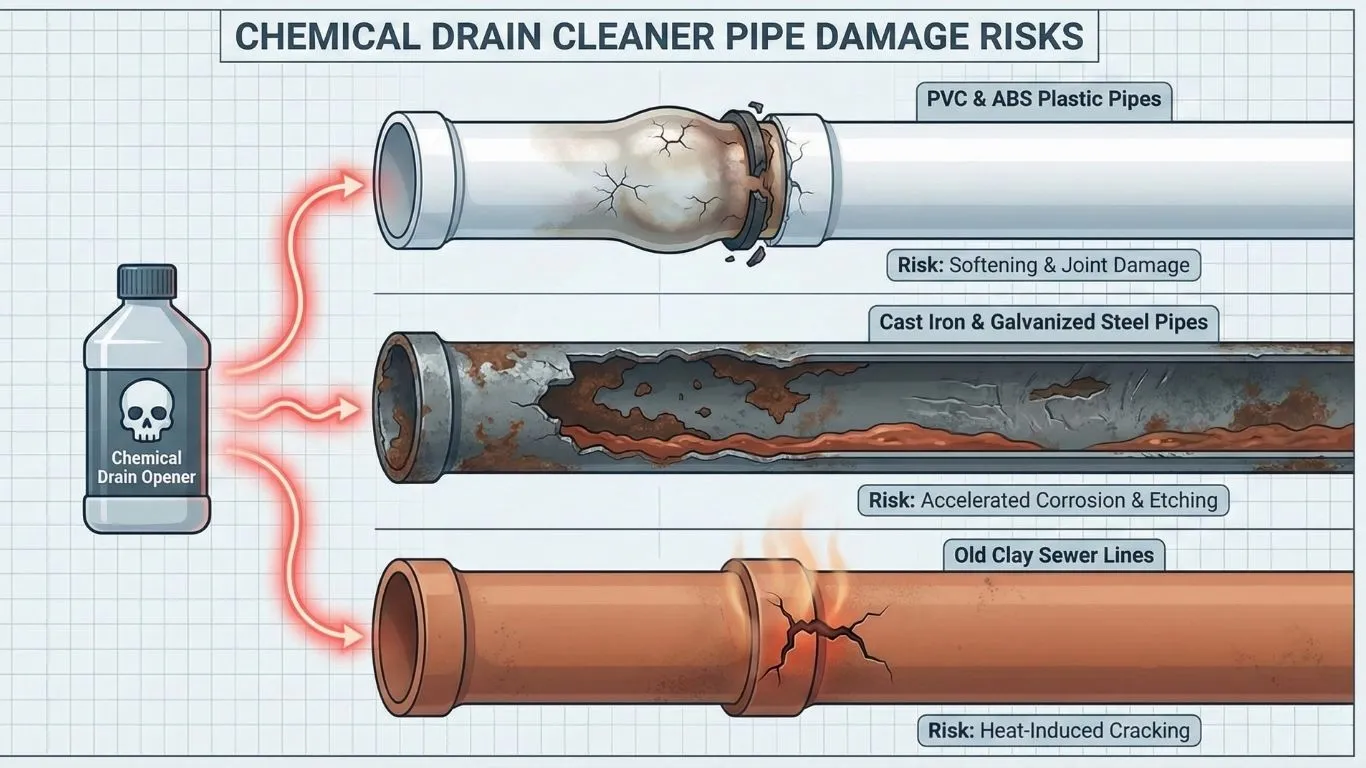
Drain Cleaner Damages Pipes. The Real Risks
Drain Cleaner Safety Risks: What You Must Know
Chemical Burn Hazards
- Skin contact: Can cause severe chemical burns within seconds
- Eye exposure: Can lead to permanent vision damage
- Inhalation: Fumes can burn the respiratory passages
Dangerous Combinations
NEVER mix drain cleaners with:
- Bleach or bleach-based cleaners (can release toxic chlorine gas when mixed with acidic drain cleaners)
- Ammonia (creates toxic chloramine vapour)
- Other drain cleaners (can cause explosive reactions)
- Vinegar or other acids (if using alkaline cleaner)
Heat and Splash Risks
An exothermic reaction can cause standing water to boil and splash out of the drain, resulting in burns.
Comparison: Chemical Cleaners vs. Professional Methods
When you are facing a slow drain or a backup, you have three main options. Here is how they compare in terms of safety and long-term effectiveness.
| Feature | Chemical drain cleaner | Mechanical snaking (DIY) | Professional hydro-jetting/snaking |
|---|---|---|---|
| Mechanism | Chemical reaction (heat) | Physical poking | High-pressure water / industrial auger |
| Effectiveness | Low (surface only) | Medium (punches a hole) | High (wall-to-wall clean) |
| Pipe safety | High risk (corrosion/heat) | Medium (scratches) | Safe (no chemicals) |
| Works on roots? | No | No | Yes |
| Best for | Slow drains, minor upkeep | Small hair clogs | Main sewer lines, grease, roots |
The Professional Approach: Seeing Before Solving
At Rooter Experts and Drain Cleaning, we believe in solving the root cause, not just treating the symptom with chemicals.
Camera Diagnostics (The “Eyes” Underground)
Before we do anything, we use high-definition sewer cameras to inspect the line. We need to know whether we are dealing with a greaseball, a tree-root intrusion, or a collapsed pipe. This transparency means you never pay for a repair you don’t need.
Motorized Snaking (Rooter Service)
For standard clogs, we use the professional-grade Rooter Service NJ homeowners trust. This involves a heavy-duty cable with a specialised cutting head that physically breaks up the obstruction and retrieves it, rather than pushing it deeper.
Hydro-Jetting (The Ultimate Clean)
For pipes clogged with years of grease or sludge, we use hydro-jetting. This shoots water at high PSI (pounds per square inch) to scrub the interior walls of the pipe clean, restoring them to near-new condition without using any harsh acid.
How Long Does Drain Cleaner Take to Work?
Standard timing:
- Alkaline cleaners: 15-30 minutes for light clogs, up to 2 hours for severe blockages
- Acid cleaners: 5-15 minutes (faster but more dangerous)
- Enzymatic cleaners: 6-12 hours minimum, best overnight
If your drain isn’t clear after the maximum recommended time on the bottle, stop using chemical drain cleaners and call a professional. Adding more product won’t help and may create dangerous chemical buildup.
When to Call a Professional
If you have tried a plunger without success, or if multiple fixtures are backing up at once (e.g., the toilet bubbles when the shower runs), you have a main line issue. No chemical can fix this.
Don’t risk your family’s safety or your home’s infrastructure with harsh acids.
Rooter Experts offers honest, Emergency Drain Cleaning Services across Northern New Jersey. We are locally owned, fully licensed, and we treat your home like our own.
Conclusion: Know When to Stop Pouring and Start Calling
Understanding how drain cleaner works helps you make smarter decisions about your plumbing. The chemical reaction is powerful, but it’s not magic—if your drain isn’t clearing, you likely have a mechanical issue that requires professional diagnosis.
Call immediately if you experience:
- Multiple drains are backing up simultaneously
- Sewage is backing up into your home
- Drain cleaner hasn’t worked after one proper application
- Recurring clogs in the exact location
- Any signs of pipe damage (leaking, visible corrosion, water stains)
As a licensed, owner-operated emergency plumbing service in Northern New Jersey, we respond 24/7 to homes throughout Bergen County, Passaic County, Moonachie, Ridgewood, Clifton, Wayne, Teaneck, Paramus, and surrounding areas. Every job includes camera inspection documentation so you see exactly what’s causing your clog—no guessing, no upselling, just honest code-compliant solutions.
Don’t waste another dollar on a drain cleaner that won’t work. Get a camera-verified diagnosis and same-day service.
FAQ About Drain Cleaners Work
Does drain cleaner work on hair?
Yes, cleaners containing sodium hydroxide or bleach can dissolve hair by breaking down the protein bonds (keratin). However, a mechanical plumbing snake removes the hair instantly without risking pipe corrosion.
How long does drain cleaner take to work?
Most labels suggest 15 to 30 minutes. If the water hasn’t gone down after that time, the chemical has failed. Do not wait hours or overnight, as prolonged exposure increases the risk of pipe damage.
Why is my drain smoking after using the cleaner?
If you see “smoke” or steam, it is likely a thermal reaction. The chemical is reacting with organic matter or, more dangerously, with another chemical previously poured down the drain. Ventilate the room immediately and leave the area.
Is drain cleaner safe for septic systems?
Generally, no. Your septic tank relies on good bacteria to break down waste. Pouring strong acids or antibacterial chemicals down the drain kills these bacteria, potentially disrupting your septic system’s balance.
Need a drain or sewer line cleared in North Jersey? Rooter Experts and Drain Cleaning offers flat-rate, camera-verified drain cleaning across Bergen and Passaic County — no upselling, no surprise charges. Call (201) 583-4778 or get a free quote.