
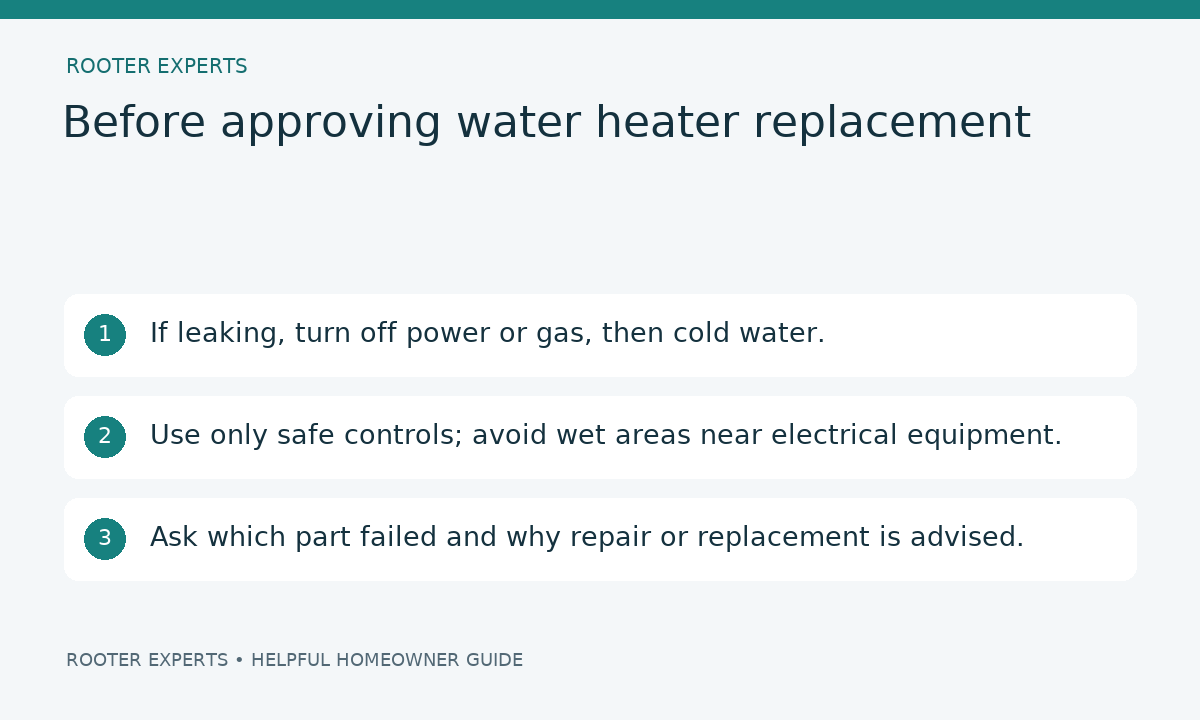
A leaking water heater does not always need replacement. Before approving a new unit, ask the service provider to identify exactly where the water is coming from and explain what failed.
In its water heater leak guide, A.O. Smith explains that loose connections and faulty drain valves may be repairable. A cracked or corroded tank typically requires replacement. The leak’s source, along with the heater’s age and condition, should guide the recommendation.
If the leak is active, address it before comparing proposals. A.O. Smith says not to keep using a leaking heater: turn off its power or gas supply, then its cold-water supply. Only use safely accessible controls; do not approach electrical equipment through standing water or handle it with wet hands. For a gas shutoff, the manufacturer limits that step to people confident in doing it. Use our leaking water heater first-steps guide for the broader safety handoff.
Ask which part is leaking
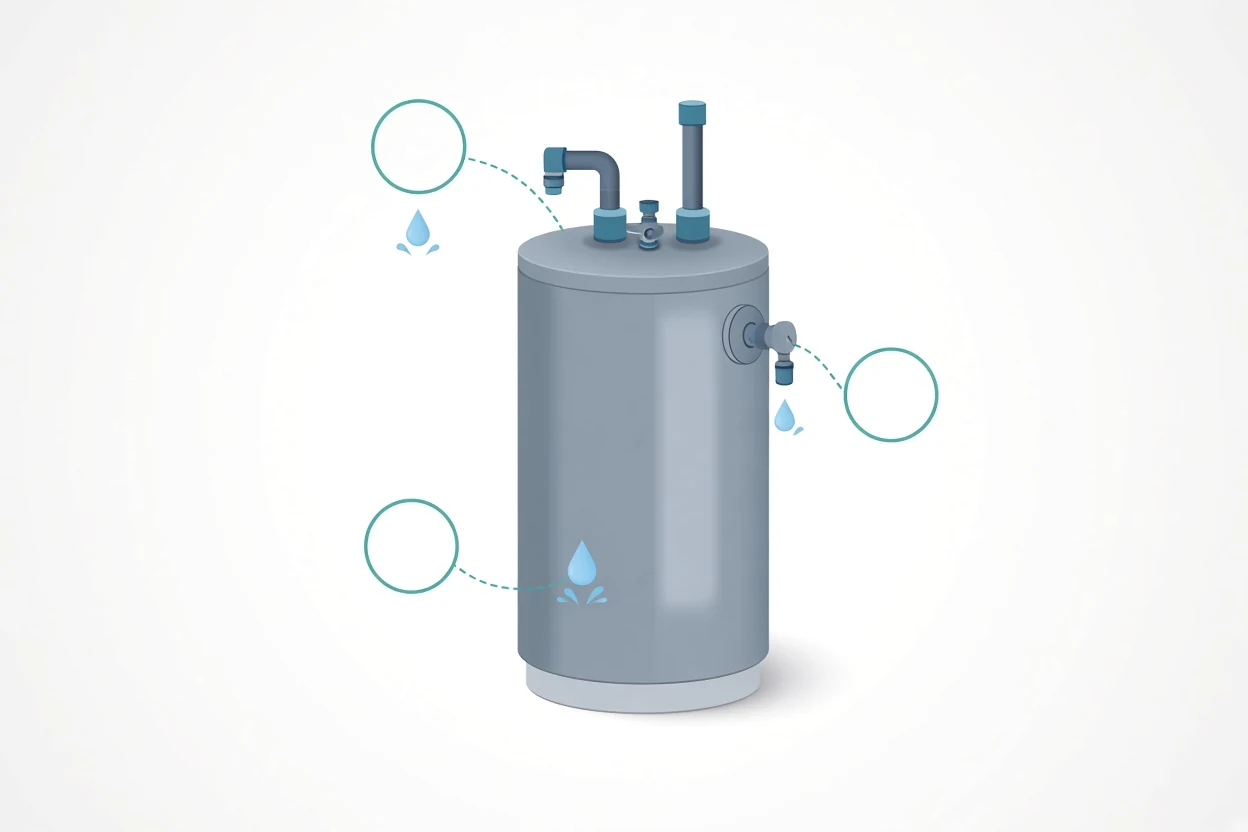
A useful diagnosis names the failed part, rather than simply saying “the water heater leaks.” A.O. Smith describes several possible sources:
- Pipe connections at the top: loose or worn connections may need tightening or replacement rather than a new heater.
- Drain valve: a faulty valve may need replacement while the tank remains in service.
- Temperature and pressure relief valve: leakage may reflect excessive temperature or pressure, or a faulty valve. The cause needs diagnosis.
- Tank itself: cracks or corrosion that cause tank leakage generally point toward replacement.
These are questions for the service visit, not instructions to adjust or replace valves yourself. Ask the technician to show you the leak location, if it can be viewed safely, and explain whether the tank is sound.
For a relief-valve leak, ask: “What caused the valve to release water, and does the proposed work address that cause?” That gives you more useful information than a recommendation to replace a part without explanation.
Does water at the bottom prove the tank failed?
Water at the base deserves prompt attention, but ask what finding supports the diagnosis. A.O. Smith says base leaks can indicate serious internal damage, such as a corroded tank, for which replacement is usually more practical.
The same guide also discusses condensation that can be mistaken for leakage. Ask whether the provider has ruled that out and confirmed the source of the water. Do not continue operating the heater just to test a theory.
A clear replacement recommendation should explain whether water is escaping from the tank itself or from a separate connection or component. “There is a puddle” describes the symptom; it does not tell you which repair is needed.
How much should age affect the decision?
Age matters, but it should not replace a diagnosis. A.O. Smith says the repair-or-replacement decision depends on leak severity, age and overall condition, and that replacing an older heater is often more cost-effective than repairing it.
Ask the provider to separate two points:
- Is replacement needed because the tank has failed?
- Or is repair possible, with replacement recommended because of the unit’s broader condition?
Those are different reasons for choosing a new heater. If age is central to the recommendation, ask how the age was established and what other deterioration was found. Our water heater lifespan guide covers that separate question in more detail.
If discolored hot water is also part of the discussion, see our rusty hot water service-or-replacement guide. Keep the leak diagnosis central rather than treating every symptom as proof of tank failure.
Review the proposed work before approving it
Request a written explanation of the diagnosis and scope. For a repair, ask which component will be repaired or replaced and how the provider will check that the problem is resolved. For replacement, ask which heater is proposed, why it suits your needs, and what the total includes.
Confirm removal of the old unit, connection work, any additional work, and applicable warranty terms. Ask whether any assessment charge is separate from the work price. These are terms to confirm with the provider, not assumptions about what is included.
Rooter Experts Drain Cleaning provides water heater service in Northern New Jersey communities including Moonachie, Hackensack and Clifton. When requesting an assessment, give your town, describe the leak you already observed, and share the heater’s model and approximate age if known. If you already have a recommendation, ask for help understanding the diagnosis and proposed work.

Talk with Rooter Experts
Call Rooter Experts at (201) 583-4778 for plumbing or drain service in Northern New Jersey.